

Where Bright Ideas
Come to Life!
Come to Life!
A cooker hood removes steam, grease and cooking smells from above your hob. Ducted hoods push that air outside and are far more effective; recirculating hoods filter it through charcoal and blow it back into the kitchen. Most hoods are fed from a fused spur with a switch you can reach, and sit 650mm to 750mm above the hob depending on the manufacturer's instructions. The hood itself can be hung by a kitchen fitter, but the electrical connection should be done by a qualified electrician and certified.
Cooker hoods, also called range hoods or extractor hoods, sit above your hob and pull away the smoke, steam, grease and smells that cooking produces. They come in all sorts of styles to suit the kitchen, but their real job is air quality: a kitchen without decent extraction ends up with greasy cupboards, steamed-up windows and, over time, condensation and mould.
That's why Building Regulations (Approved Document F) require extract ventilation in kitchens. One thing that catches people out: a recirculating hood doesn't count as extract ventilation, because it doesn't move any air outside. If yours is recirculating, you may need a separate extractor fan or another form of ventilation to meet the regs on a new kitchen. See our Extractor Fans and Positive Input Ventilation sections for more on that.

Recirculating cooker hood installed above a hob in a Tunbridge Wells kitchen

The main types are wall-mounted chimney hoods, island hoods hung from the ceiling over a kitchen island, integrated or canopy hoods built into the wall units, under-cabinet hoods, ceiling hoods and downdraft hoods that rise out of the worktop behind the hob.
From an electrician's point of view, the type matters because it decides where the power needs to be. Island and ceiling hoods need the supply run before the ceiling is boarded or plastered. Downdraft hoods need space and a supply in the base unit below. Wall and integrated hoods are usually the simplest, with the supply coming into the cupboard or chimney section above. Get the type decided before first fix and you'll avoid chasing walls later.
Think of it this way: a ducted hood is like taking the rubbish out, while a recirculating hood is like spraying air freshener. The recirculating one helps, but the steam is still in the room.
A ducted hood pushes air outside through ductwork and a grille in the wall or roof. It's the more effective option and the one that properly deals with moisture. For best performance the duct run should be as short and straight as possible, use rigid ducting rather than flexible hose, and finish at an outside grille with a back-draught flap.
A recirculating hood draws air through grease filters and charcoal filters, then returns it to the kitchen. It's the right choice where ducting outside isn't practical, such as an internal wall or a flat where you can't core drill through, but you'll need to replace the charcoal filters regularly.
One safety point worth knowing: if you have an open-flued gas appliance in the same space, such as an older boiler or gas fire, a powerful ducted hood can pull combustion fumes back into the room. In that case have a Gas Safe engineer check it before the hood goes in.
Most manufacturers specify between 650mm and 750mm above the hob, with gas hobs usually needing the higher end. Always follow the instructions that come with your hood, because they take priority and your warranty may depend on it. Too low and you've got a fire risk and a hood you'll bang your head on; too high and it won't capture the steam properly.
The hood should be at least as wide as your hob, and ideally a little wider. Style is down to you, whether that's sleek stainless steel, glass or something built into the cabinetry to match the kitchen.
Most cooker hoods are hard-wired from a fused connection unit, often called a fused spur, with the fuse sized to the manufacturer's rating (usually 3A or 5A). You need a way to isolate the hood for cleaning and repairs, so we typically fit either a switched fused spur somewhere you can reach, or an unswitched one in the cupboard above with a separate switch at worktop level. You can read more in our Fused Spurs & Isolation Switches section.
Some hoods come with a plug instead. That's fine, but the socket needs to be somewhere sensible, usually in the cupboard above, not behind the hood where you can't get to it.
In England, adding a spur to an existing circuit in a kitchen isn't notifiable under Part P, but it still has to be done to BS 7671. When we do it, we check the circuit can take the extra load and that it's RCD protected, and you get a Minor Works Certificate. If a new circuit is needed, that is notifiable, and we register it through the NICEIC.
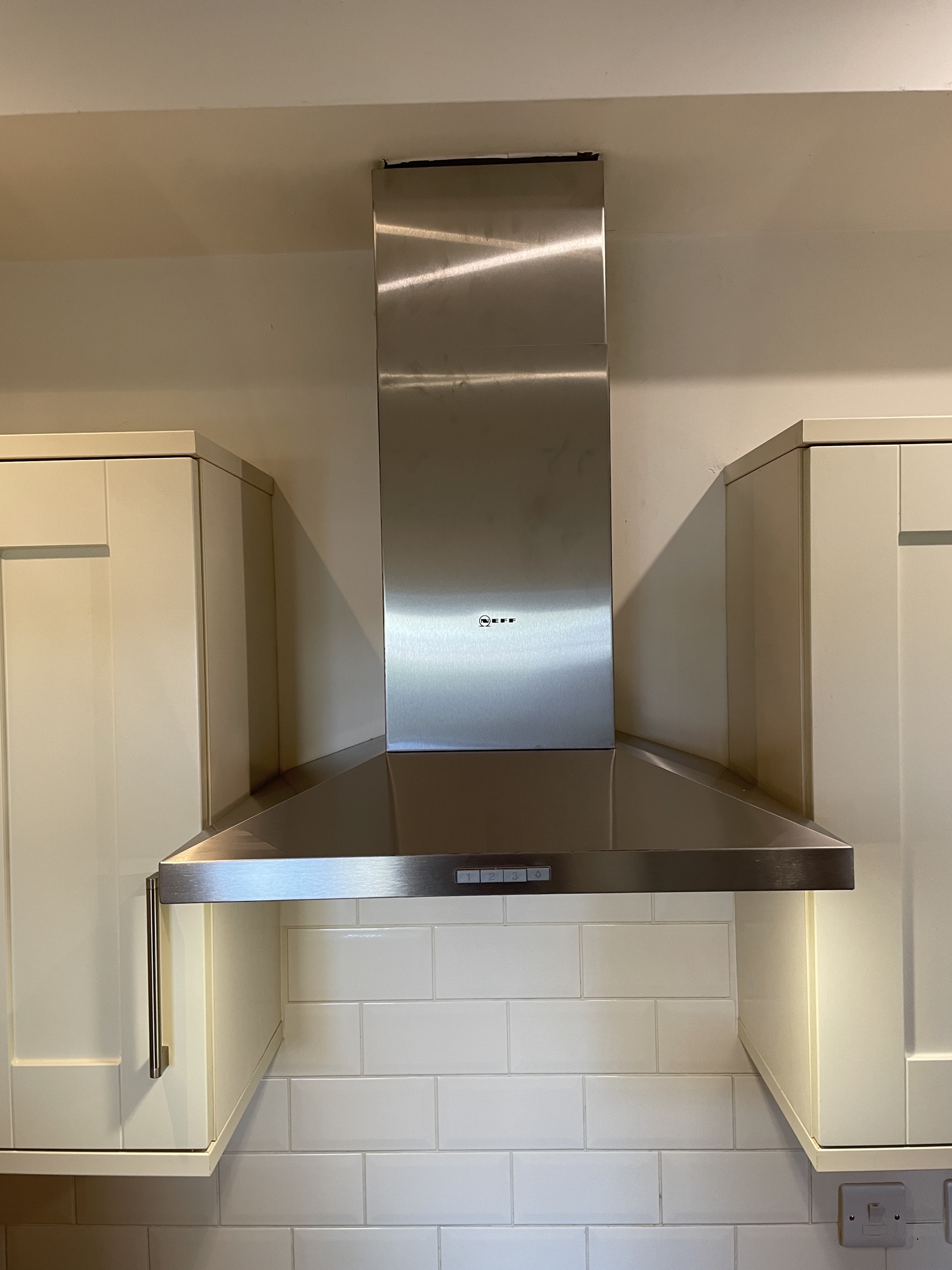
Wall-mounted recirculating cooker hood above a stove on a tiled wall
A typical installation means deciding on the hood and its position, planning the duct route if it's ducted, core drilling through the external wall, fitting the mounting brackets, running the power supply and isolation, connecting and testing the hood, then certifying the electrical work.
On new kitchens it's usually a joint job: the kitchen fitter hangs the hood and cabinets, and the electrician puts the supply and isolation in at first fix, then connects and tests at second fix. Getting the order right saves a lot of hassle, which is why we've written a separate guide to scheduling the trades on a new kitchen.
For a straightforward replacement on an existing supply, small works like this are usually booked within one to two weeks.
Clean the metal grease filters regularly. Most can go in the dishwasher, and once a month is a good rule of thumb if you cook most days. A grease-clogged filter isn't just inefficient, it's a fire risk sitting right above your hob.
If yours is recirculating, replace the charcoal filters as often as the manufacturer recommends, typically every three to six months. Wipe down the outside of the hood to stop grease building up, and always switch it off at the isolator before cleaning inside.
Start with the simple things. Check the switch on the fused spur is on and the fuse hasn't blown. If you're changing the fuse, isolate it first and replace it with the same rating. If the lights work but the fan doesn't, that usually points to the motor or the control board rather than the supply.
Weak suction is nearly always clogged filters, crushed flexible ducting or a back-draught flap that's stuck shut. Rattling or humming can be loose ducting or a motor on its way out. If the hood trips the RCD, stop using it and get it looked at, because that means there's a fault to earth somewhere.
Cooker hoods carry an energy label like other appliances, so it's easy to compare. Look for efficient brushless motors, LED lighting, and an automatic sensor mode that adjusts the fan speed to how much steam there is, rather than leaving it on full. They cost a little more upfront but are quieter and cheaper to run.
Hanging the hood is within reach of a confident DIYer or your kitchen fitter. The electrical side is where we'd recommend a professional. Legally, you can carry out non-notifiable electrical work yourself in England, but it still has to meet BS 7671, and if something goes wrong your insurer will want to know who did it and whether it was certified.
A qualified electrician will also spot the things that cause problems later: an overloaded circuit, no proper isolation, or a supply sitting where the hood bracket needs to go.
The right cooker hood makes a real difference to how your kitchen feels to cook in and how well it lasts. Go ducted if you can, size it to your hob, mount it at the height the manufacturer specifies, and get the supply and isolation put in properly. Do that and it'll quietly do its job for years.
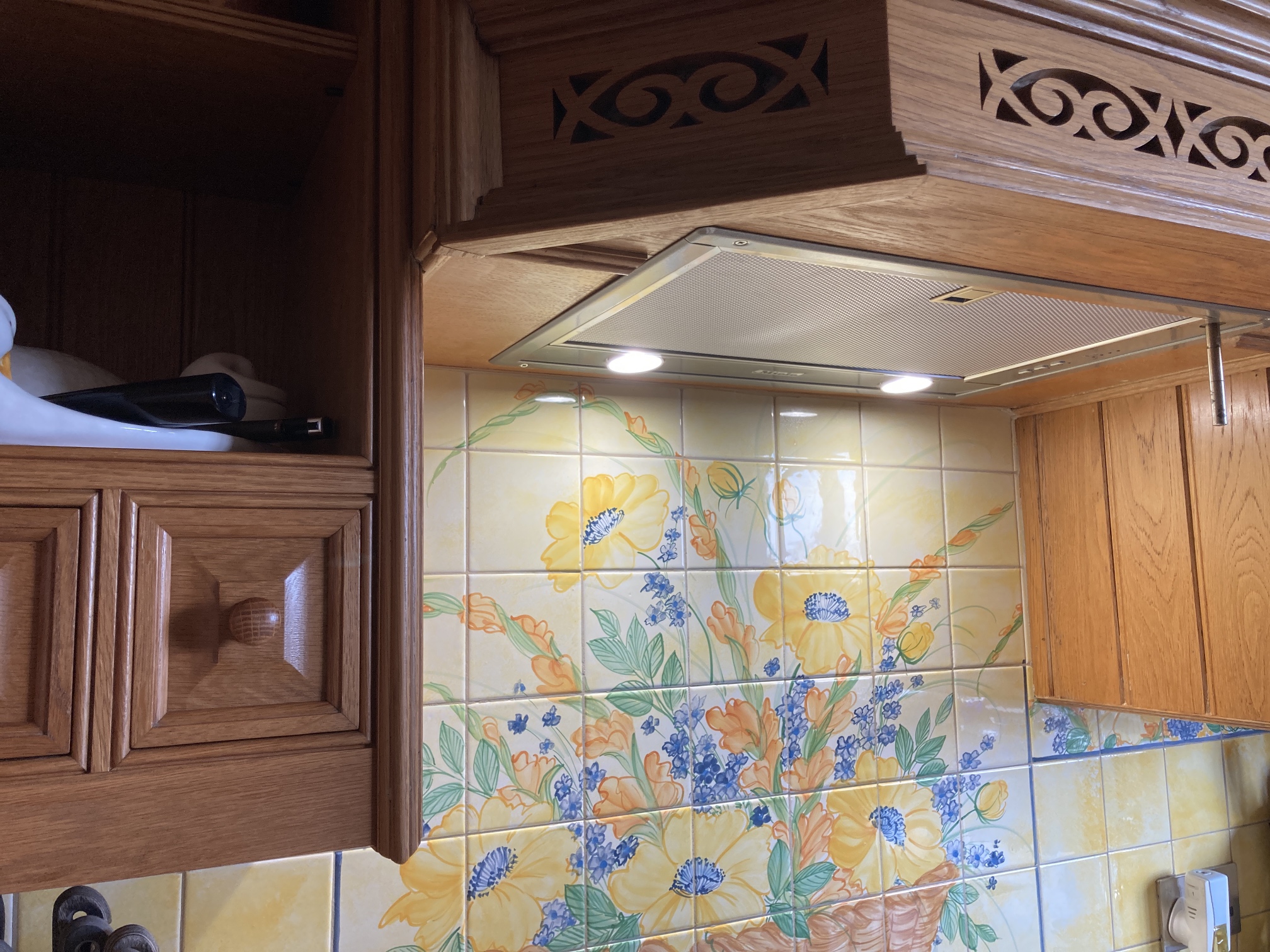
Replacement integrated cooker hood fitted into kitchen wall cabinets
Choosing the right cooker hood can significantly enhance your kitchen experience by improving air quality and adding a stylish element to your decor. With various types, styles, and installation options available, it’s essential to consider your specific needs and preferences. Whether you opt for a recirculating model or a ducted system, investing in a quality cooker hood will ensure a more enjoyable and healthier cooking environment.
The hood itself can be hung by a kitchen fitter, but the electrical connection should be done by a qualified electrician. It has to meet BS 7671, needs proper isolation, and should be certified with a Minor Works Certificate.
Most manufacturers specify between 650mm and 750mm above the hob, with gas hobs usually at the higher end. Always follow the instructions supplied with your hood, as they take priority.
Ducted is better. It removes steam, grease and smells from the house completely, while a recirculating hood filters the air and returns it to the kitchen. Choose recirculating only where ducting outside isn't practical.
It needs a way to be isolated for cleaning and repairs. That is usually a switched fused spur within reach, or an unswitched fused spur in the cupboard above with a separate switch at worktop level.
Usually 3A or 5A, but always check the rating plate and the manufacturer's instructions. If a fuse blows repeatedly, don't fit a bigger one; get the hood checked for a fault.
Yes, if the hood is supplied with a plug. The socket should be in an accessible position, usually the cupboard above, so the hood can be unplugged to isolate it.
A recirculating hood doesn't count as extract ventilation under Approved Document F, because it doesn't move air outside. On a new kitchen you may need a separate extractor fan or other ventilation alongside it.
Clean metal grease filters about once a month if you cook most days. Replace charcoal filters on recirculating hoods as often as the manufacturer recommends, typically every three to six months.
Swapping a hood on an existing supply is a small job. Adding a new fused spur and ducting through an external wall takes longer. Bright Spark gives a fixed price after a free survey; see our Rates & Fixed Prices page for our current rates.

Whether it's a straight swap or a new hood as part of a kitchen refit, a Bright Spark electrician can survey the job and give you a free, fixed-price quote. We cover Tonbridge, Tunbridge Wells, Sevenoaks, Crowborough and the surrounding area.
Request your free quote: https://www.brightsparkelectrician.co.uk/request-a-quote/
Call: 01892 531728 Email: karen@brightsparkelectrician.co.uk

For further Information, please do not hesitate to contact us.
Telephone: 01892 531728
Email: karen@brightsparkelectrician.co.uk
We recently appointed Bright Spark Electrical Services for upgrading our home electrics. Initially their quotation submitted was very professional, every detail of work to be carried out was itemised. The work was completed very efficiently and very speedily. In fact a good tidy electrical job. I believe in giving credit where it is due I would recommend Bright Spark Electrical Services not only for the work completed in my home, but also for their impressive record, which can be easily checked.
I was really impressed with the work done for me by Bright Sparks. It is lovely that they are local to me in Hildenborough and grateful that they could fit me in at short notice. The repairs were done quickly and easily by Charlie and the whole thing coordinated by Karen who kept me informed every step of the way. Well done Bright Sparks!
We used Bright Sparks to resolve some electrical problems. They succeeded where previous electricians failed! We found them to be reliable, courteous and fairly priced.
What is really great about Bright Spark Electrical is that they communicate well and get the job done precisely exactly as agreed and bang on time. The job is thoroughly discussed beforehand, you know who is coming and when and have a full list of the parts to be installed. They perform tasks efficiently with no mess. They have done jobs for me in Tunbridge Wells, both in the Culverden Down area and at High Brooms and I would recommend them
I would like to thank Karen and Louise for their good work and considerate approach. I am very pleased and would recommend them for their efficiency and fair price.